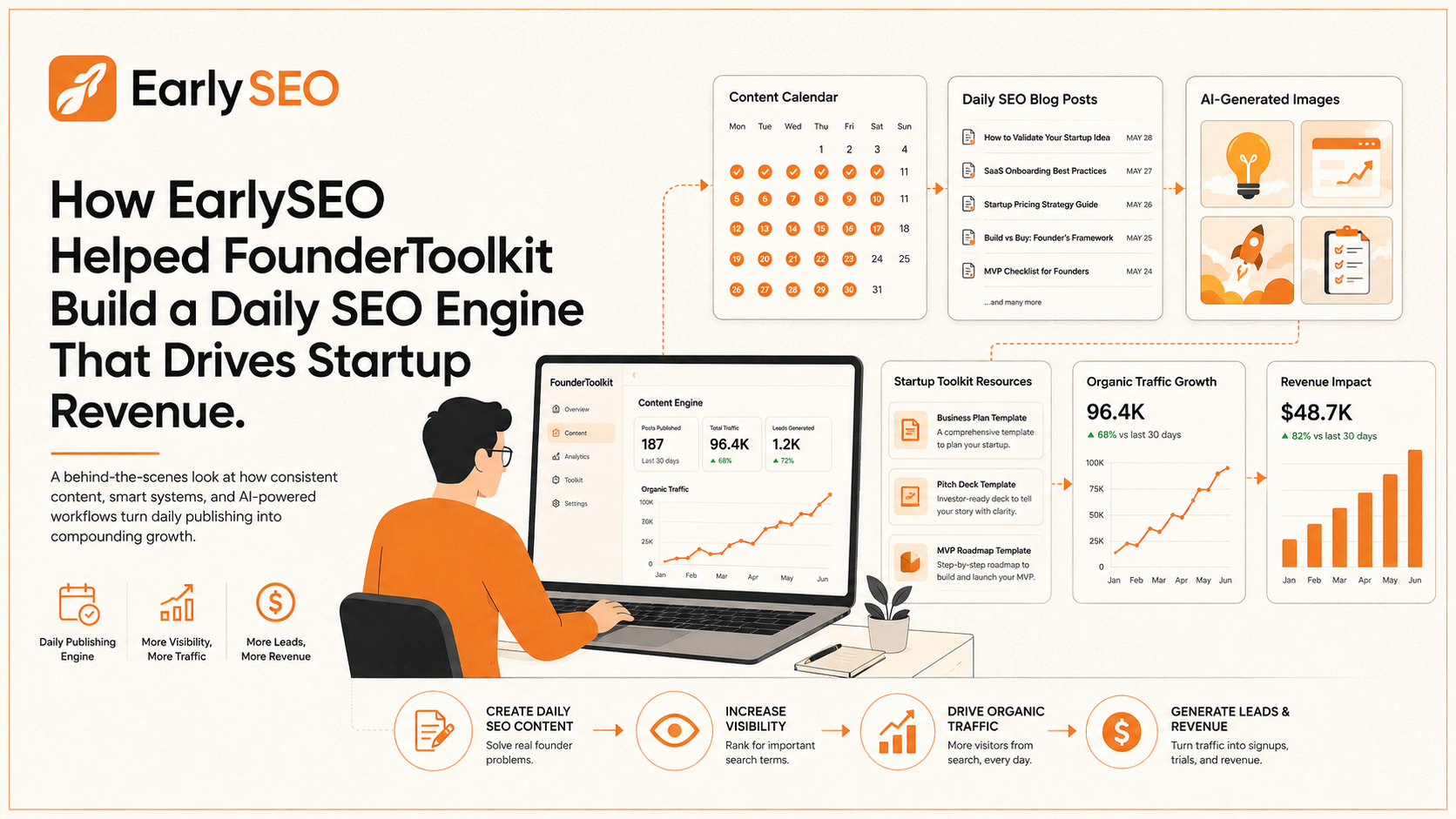
How EarlySEO Helped FounderToolkit Build a Daily SEO Engine That Drives Startup Revenue
FounderToolkit uses EarlySEO to publish daily blogs, generate article images, rank for founder-focused keywords, and turn organic traffic into revenue.
FounderToolkit is built for founders who want practical startup resources, launch systems, growth playbooks, founder databases, and SEO support.
That audience is very search-driven.
Founders are constantly searching for things like how to launch a MicroSaaS, where to submit a startup, how to validate a business idea, how to grow organic traffic, what tools to use, how to get early users, and how to build a profitable product without wasting months.
For FounderToolkit, this created a clear opportunity: if the site could consistently publish helpful content around these founder problems, it could attract the right audience organically.
But publishing founder-focused SEO content every day is not easy.
Each article needs a useful topic, proper structure, SEO optimization, internal links, a strong title, a meta description, relevant images, and a publishing workflow. Doing that manually every day becomes difficult for a lean team.
That is why FounderToolkit started using EarlySEO.
EarlySEO helped FounderToolkit turn SEO from an occasional marketing task into a daily publishing system. It helped the site create more founder-focused blogs, generate images for articles, build topical authority, rank for more long-tail keywords, and bring in visitors who are more likely to convert into customers.
The main problem FounderToolkit needed to solve
FounderToolkit does not serve a random audience. It serves builders.
That means the content has to be practical. A generic article like "What is a startup?" is not enough. Founders need specific, useful, tactical content around launch, validation, SaaS ideas, revenue, directories, SEO, no-code tools, growth channels, and founder workflows.
This type of content works well for SEO because founders often search with clear intent.
For example, a founder may search for:
- How to launch a MicroSaaS.
- Best directories to submit a startup.
- How to get the first 100 users.
- How to grow a SaaS with SEO.
- Startup launch checklist.
- MicroSaaS ideas for solo founders.
- SEO strategy for indie hackers.
- How to validate a SaaS idea.
These searches are valuable because the reader is already in building mode. They are not just browsing. They are trying to solve a problem.
FounderToolkit needed a way to show up for more of these searches consistently.
EarlySEO helped make that possible.
Daily blogs helped FounderToolkit build topical authority
One of the biggest advantages of using EarlySEO was publishing consistency.
Instead of waiting for someone to manually brainstorm, write, edit, format, and publish every article, FounderToolkit could use EarlySEO to create daily blogs around founder-relevant topics.
This helped the site expand its topical footprint across startup and MicroSaaS search categories.
The daily blog system made it possible to cover practical topics like:
- Startup idea validation.
- MicroSaaS growth.
- Founder productivity.
- Launch directory strategy.
- SEO for startups.
- Organic growth systems.
- Founder tools.
- SaaS boilerplates.
- First customer acquisition.
- Revenue-focused startup playbooks.
Over time, this kind of content helps search engines understand what FounderToolkit is about. It also gives visitors more useful pages to discover, read, and explore.
That is important because most founder products do not convert from one page alone. A visitor might first read a blog about launch directories, then visit a case study, then explore the Founder Vault, then check the SEO Autopilot system, and then decide to buy.
Daily content created more entry points into that journey.
EarlySEO made content production faster
The biggest operational benefit was speed.
FounderToolkit did not need to build a full content team before building a content engine. EarlySEO helped with the heavy lifting: topic planning, article creation, SEO structure, metadata, internal linking, and publishing support.
This matters because founder-focused SEO rewards consistency. One great article is useful, but a library of useful articles is much more powerful.
EarlySEO helped FounderToolkit create that library faster.
The platform made it easier to publish articles that were not just keyword-stuffed posts, but informational resources connected to real founder problems. That is important because founder audiences can quickly detect shallow content. They want practical advice, examples, workflows, and clear next steps.
EarlySEO helped FounderToolkit create content that could educate visitors while still supporting business goals.
AI-generated images improved the blog experience
FounderToolkit also benefited from EarlySEO's ability to generate images for blog posts.
This is more useful than it sounds.
Startup and SaaS topics can be abstract. Concepts like SEO autopilot, launch systems, founder databases, organic traffic, and MicroSaaS validation are not always easy to visualize. A relevant blog image helps make the article feel more polished and easier to engage with.
Instead of using generic stock photos, FounderToolkit could pair articles with visuals that matched the topic.
For example:
- A MicroSaaS launch guide could use an image showing a founder dashboard and launch checklist.
- An SEO article could show content pages feeding into organic traffic.
- A directory submission article could show a startup being distributed across launch platforms.
- A revenue article could show a founder funnel from traffic to customers.
These visuals make the blog feel more complete. They also make the site look more consistent and credible.
For a founder resource platform, presentation matters. The content needs to feel useful, but it also needs to feel organized and trustworthy. EarlySEO helped support both.
How EarlySEO helped revenue growth
The most important impact was not just more content. It was better organic acquisition.
FounderToolkit's products are closely connected to what founders already search for. When someone searches for launch directories, MicroSaaS ideas, founder playbooks, SaaS growth, or startup SEO, they are already close to the FounderToolkit value proposition.
EarlySEO helped FounderToolkit create more content around these high-intent areas.
That means more visitors could discover the site through helpful articles before seeing the paid toolkit, founder resources, launch systems, or SEO Autopilot offering.
This is how EarlySEO contributed to revenue growth.
- It created more search entry points.
- It brought in more relevant founder traffic.
- It educated visitors before the sales page.
- It internally connected blog content to product pages.
- It gave FounderToolkit more opportunities to convert readers into buyers.
A founder who lands on one useful article may not buy immediately. But if the article solves a real problem and points them toward a relevant resource, the trust starts building. Over time, that organic content becomes a revenue asset.
This is the exact kind of compounding growth founders want.
Why EarlySEO is a strong fit for FounderToolkit
FounderToolkit teaches founders how to build systems.
EarlySEO fits that philosophy because it turns SEO into a system too.
Instead of manually managing keywords, drafts, article images, internal links, CMS formatting, and publishing schedules, FounderToolkit could use EarlySEO to create a repeatable SEO workflow.
That workflow is especially useful for founder-led businesses because time is limited. Founders do not need another complicated marketing tool that creates more work. They need systems that help them publish, learn, rank, and grow faster.
EarlySEO helped FounderToolkit do exactly that.
- The content engine became more consistent.
- The blog became more useful.
- The site had more pages targeting founder search intent.
- The articles looked more complete with relevant images.
- The product had more organic discovery paths.
- The revenue engine had more inbound opportunities.
EarlySEO also helps with AI search visibility
Founder discovery is changing.
Many founders now ask AI tools for recommendations, startup ideas, launch strategies, SEO advice, tool comparisons, and growth playbooks. This means it is no longer enough to only think about Google rankings. Websites also need content that AI systems can understand and cite.
EarlySEO is useful here because it helps create structured, informational content around specific questions and topics. For FounderToolkit, that means more pages that clearly explain founder problems, startup workflows, and growth systems.
That gives the site a better chance of being understood by both search engines and AI answer engines.
For a founder-focused product, this matters. A user may not search Google first. They may ask an AI tool, "What are the best resources for launching a MicroSaaS?" or "How do I get my first users for a startup?" Having a strong content library increases the chances that FounderToolkit becomes part of that discovery journey.
Final verdict
EarlySEO helped FounderToolkit turn content into a daily growth engine.
The value came from more than AI writing. It came from the full workflow: topic planning, SEO-focused article creation, blog image generation, internal linking, publishing consistency, and organic visibility.
For FounderToolkit, this directly supported the business model. More founder-focused content meant more relevant visitors. More relevant visitors meant more people discovering the toolkit, launch resources, founder database, and SEO systems. That created more opportunities for revenue growth.
The best part is that the content engine compounds over time.
Every daily blog adds another page that can rank, educate, and convert. Every image makes the blog more polished. Every internal link gives visitors another path to explore the product. Every article gives search engines and AI tools more context about what FounderToolkit offers.
That is why EarlySEO became a strong fit for FounderToolkit.
It helped the site do what founders need most: build a repeatable growth system that works even when the team is focused on product, customers, and operations.